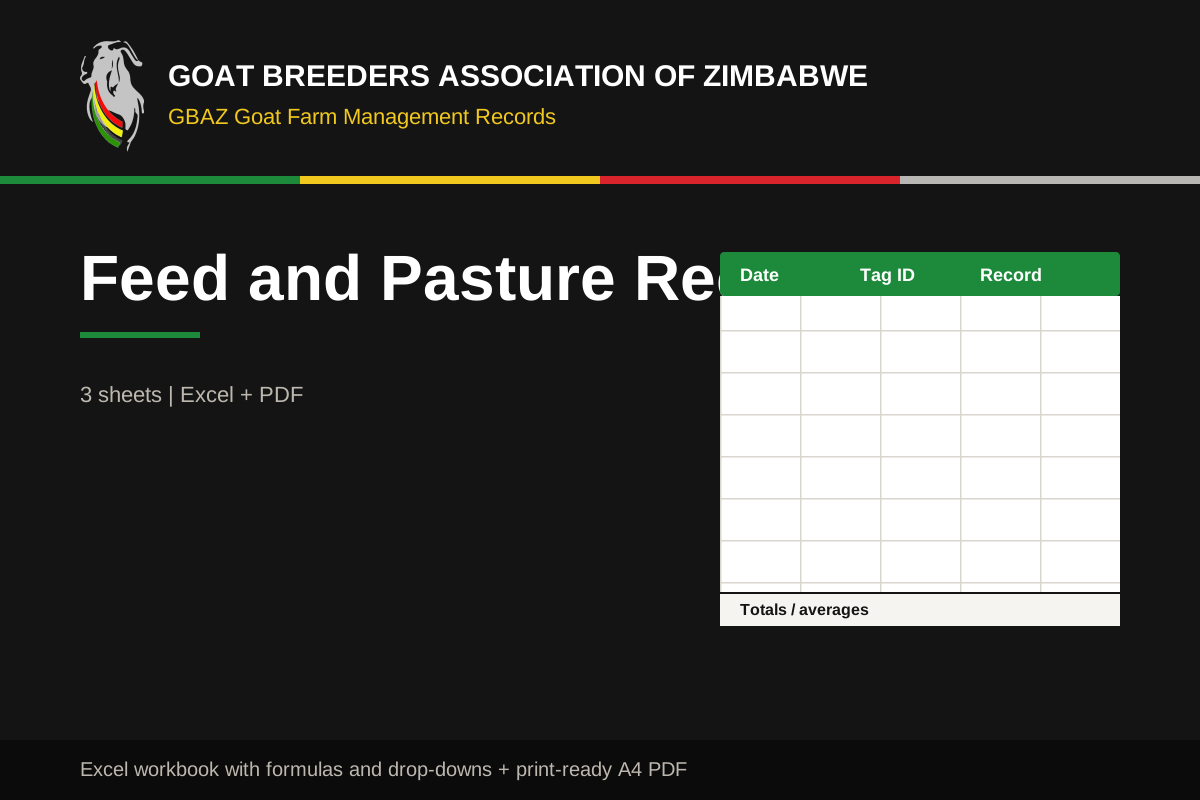
Feed and Pasture Record
Track every feed bought or cut, what it cost and how much each goat ate per day, and keep a paddock grazing diary with days grazed, stocking pressure and rest periods. A summary sheet totals quantity and cost by feed type automatically.
2 files to download
- XLSXExcel workbook (.xlsx)
- PDFPrint-ready PDF (A4)
Downloads unlock on your private order page as soon as payment is confirmed, and a link is emailed to you.
Track every feed bought or cut, what it cost and how much each goat ate per day, and keep a paddock grazing diary with days grazed, stocking pressure and rest periods. A summary sheet totals quantity and cost by feed type automatically.
What is included
- Excel workbook (.xlsx) with 3 data sheets (Feed Record, Feed Summary, Pasture Record), an Instructions sheet and a Lists sheet that feeds the drop-downs. Opens in Excel 2010 or later, LibreOffice and Google Sheets.
- Print-ready A4 PDF (landscape) with GBAZ branding, ruled rows, an instructions panel and a notes box on every page.
- Farm details block, yellow input cells, drop-down lists, data validation, frozen headers, filters and print titles on every sheet.
Feed Record
Record each batch of feed when it is bought, cut or opened. Quantity times cost per kg gives the total cost. Enter how many goats it fed and for how many days to see the intake per goat per day. Home-grown feed can be given a cost of zero or a market value: be consistent.
Columns: Date, Feed type, Source, Fed to, Quantity (kg), Cost per kg (USD), No. of goats, Days fed, Notes. Calculated: Total cost, kg per goat per day.
Summary cells: Feed entries; Total feed (kg); Total feed cost (USD); Average cost per kg; Average kg per goat per day.
Feed Summary
This sheet fills itself from the Feed Record using SUMIFS and COUNTIF. It shows which feeds take most of your money so you can compare them with the gains recorded on the Weight and Growth Record.
Columns: Feed type. Calculated: Total kg, Total cost, Share of feed cost, Entries.
Pasture Record
One row each time the flock moves into a paddock or grazing area. Days grazed and the stocking pressure (goat grazing days per hectare) are calculated. Days rested counts from the date out so you can see whether a paddock has had its rest period before the goats return.
Columns: Paddock / grazing area, Size (ha), Date in, Date out, No. of goats, Condition going in, Condition coming out, Season, Water, browse, poisonous plants, notes. Calculated: Days grazed, Goat grazing days per ha, Days rested since.
Summary cells: Grazing periods; Total grazing days; Average days per paddock.
Formulas
Total cost = quantity x cost per kg; kg per goat per day = quantity / goats / days; days grazed = date out - date in; goat grazing days per ha = days x goats / hectares; days rested = TODAY() - date out. The Feed Summary uses SUMIFS and COUNTIF by feed type.
Benchmarks and good practice
- Goats eat about 3 to 4 percent of body weight in dry matter per day: a 40 kg doe needs roughly 1.2 to 1.6 kg of dry feed, most of it from browse and grazing in a good season.
- In the dry season (August to October) supplement does in late pregnancy and lactation and growing kids: 200 to 300 g per day of a protein concentrate or legume hay keeps kidding weights up.
- Rest paddocks for at least 30 to 45 days in the rains to break the worm cycle; graze kids ahead of adults on the cleanest paddocks.
- Provide a mineral lick and clean water at all times; a goat drinks 3 to 5 litres a day in hot weather.
Layouts follow the record books recommended by extension services (FAO, ILRI, Heifer International Zimbabwe, Cornell Small Farms, Uganda MAAIF and WormBoss guidance), adapted for Zimbabwean goat breeders by GBAZ.
Goat Breeders Association of Zimbabwe
Sold on the GBAZ platform on behalf of Goat Breeders Association of Zimbabwe, who delivers the product.